A Tale In The Desert
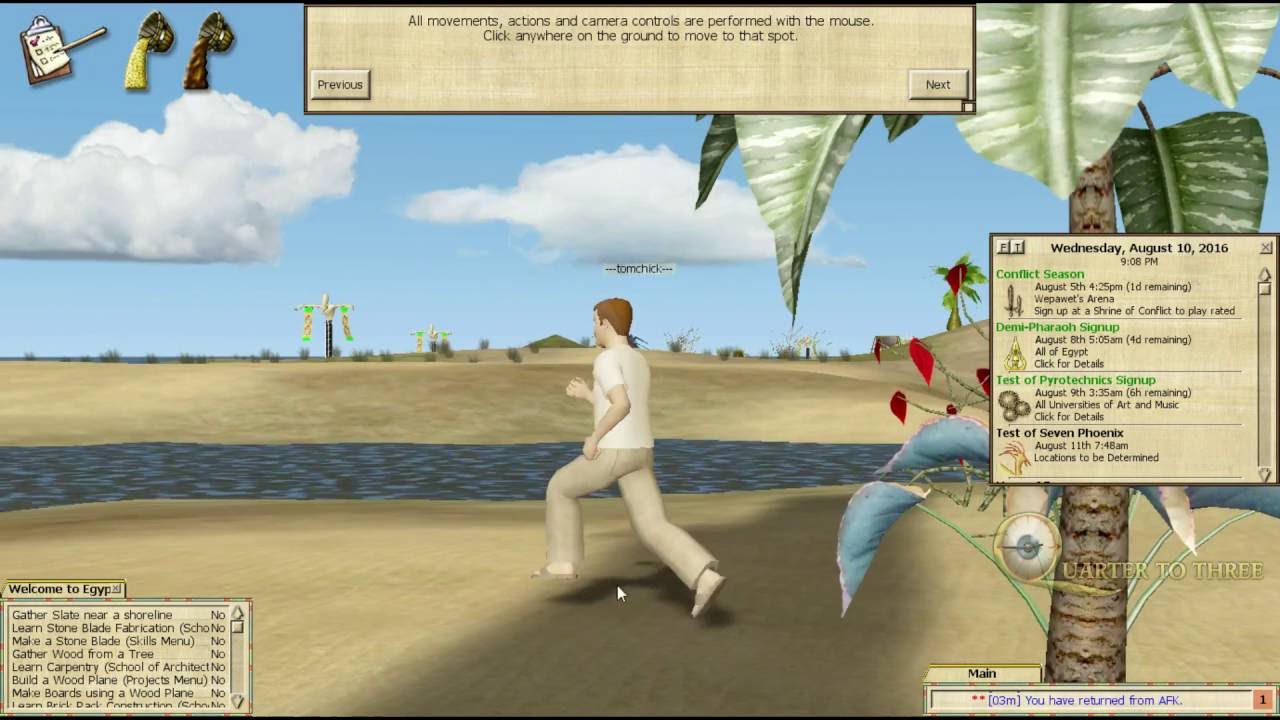
While most massively multiplayer games are firmly focused on killing and looting, a small American company called eGenesis is working on a radically different approach to online gaming. There are no monsters to battle, no dungeons to explore, no experience points or levels. Instead the emphasis is on construction and cooperation. Which turned out to be a refreshing change when we took a beta version of the game for a spin recently.
Tale 9 Pre-Orders are now available at Tale 9 will be 15 months long, new Full Tale subscription price is $159.95. Full Tale Subscription gains access to T9 Alpha. Full Tale Subscription gains access to T9 Alpha. A Tale in the Desert (ATitD), by eGenesis and Pluribus Games, is a sandbox of immense proportions that expand horizons much more due to the game’s deep crafting. Hailed as one of the few true crafting games remaining, as well as an interesting social experiment, ATitD manifests its greatest strength through forming of communities and the.
The Team Works
Set in ancient Egypt, A Tale In The Desert is such a departure from the conventions of the genre that it's hard to say whether or not it's really massively multiplayer. For starters the game has a definite beginning and end, with players working together or competing against each other to complete tasks, uncover new technologies and pass tests in a variety of disciplines. All of which has an impact on the world in which you live, which is a far cry from the static settings of most massively multiplayer games. From the moment you enter the game you'll be gathering resources and constructing buildings. As you learn new skills you can start to build up your own little settlement, starting out with some flax gardens and a couple of brick moulds and working your way up from there to larger projects such as pottery kilns, charcoal furnaces and mines. These can be either restricted to your own use, opened up to other members of your guild or even donated to the public, something which was surprisingly common during the last beta test. Partly this is thanks to the abundance of resources. Obviously sand and mud are in plentiful supply, and you can grab as much as you want with a couple of mouse clicks. Grass is also surprisingly common for a game with the word 'desert' in the title, and leaving it to dry in the sun for a few minutes after picking it will turn the grass into more useful straw. Wood can be pulled from trees, although these are few and far between in most areas and take a few seconds to replenish after they have been harvested. Again, you can use the wood directly as fuel for your kilns and furnaces or cut it up into boards for construction. Some of this can be a little time consuming, but usually there's plenty to keep you busy while you wait for your bricks to dry off, and thankfully anything in a building belonging to you is your personal property and can't be picked up by other players while you're off searching for silt along the river bank or taming camels in the distant desert.
Industrial Wasteland
This might all seem a little overwhelming when you first start playing, and indeed there's precious little in the way of in-game help. Instead players must rely on each other, and thanks to the mentor system more experienced players are actively encouraged to help out newcomers to Egypt. One of the tasks on the path of leadership requires you to show people how to gather resources and construct some basic buildings, at which point they can build a shrine in your honour. Get enough shrines and you complete the test. Not to mention the fact that having little brick shrines scattered all over the game world praising your name is something of an ego boost. Leadership isn't just about passing tests though. You can also set up your own guild so that players can share tools and buildings and construct a big guild house to act as their base. Politics plays its part as well, and Tale In The Desert is one of the few online games that allows players to have a say in how their world is run. New laws can be written by gathering enough signatures on a petition to trigger a vote which every player can take part in. During the last beta, for example, one enterprising player tried to pass a law to stop people creating buildings right next to existing camps. Indeed, this was one of the few major problems to emerge during the beta. By the end of the three days some parts of the game world had turned into a vast industrial sprawl of wall-to-wall mines, fields, carpenter's shops, kilns, furnaces and houses, and there was nothing you could do to stop a neighbour from covering your back yard with his own buildings and fields. There was also a total lack of sound effects and music in the beta, which kept the download size to a minimum but did sap the game of atmosphere. Our only other concern at this point was that the hardcore players were putting in several hours a day and rapidly working their way through the tech tree, which meant that while some people were still banging bits of stone together and trying to work out how to build their first kiln, others were already building vast monuments and complex machines by the third day. Unless there is far more to the tech tree than we have seen so far, the rate of advancement will need to be greatly slowed down to avoid games ending within a week or two of them starting. Judging from the beta though A Tale In The Desert is shaping up to be a novel and surprisingly entertaining new take on the massively multiplayer genre, with a much greater emphasis on community and co-operation between players as they work together to turn Egypt into a thriving civilization.
-
Contents.Gameplay A Tale in the Desert is a social MMORPG which does not include combat. Instead, a variety of social activities provide for the basis of most interaction in the game.
The game's main focuses are building, community, research and personal or group challenges called 'Tests'.ATitD has a global foregame, midgame, and endgame: on average so far, every year and a half the game ends, achievements are tabulated, and a new 'Telling' begins, with certain modifications requested by the player base. Within a Telling, players can write, introduce, and pass laws (including player bans), and make feature requests.There is an in-game economy, including an amount of or global trade; however, there is no official, backed for the most part, and efforts to implement them have met with little success. Additionally, there are sufficient activities to be learned and performed that it is considered exceedingly difficult to be a: this too lends itself to a much more social aspect. A recurring theme is a 'newbie island' which established players can enter at any time: this allows them to train new players at their own leisure, and introduce them to the specifics of the game. After completing a series of tasks given to them, players may make their way to the mainland and begin the real game.When a new player exits the welcoming island, they may immediately begin trekking around to look for a suitable settlement location or community. Upon reaching the mainland, the first goal of most players is to begin the central challenges of the game (Tests), find public resources, and expand upon what knowledge they have while integrating themselves into the community at large.ATITD has a, a controlled variant on which is generally restricted by what the developers can code, as well as the nature of such a system.
With the legal system, players have the option to create petitions of various types, from the redistribution of expired accounts' materials, the direct ban of a player, or even a change in an avatar's sex. The legal system as currently defined can only restrict players' options, alter ownership rights, or change a minor portion of a challenge; however, within those options, the possibilities have not been exhausted. Finally, the legal system also requires a great deal of cooperation between players, as a must be spread, signed, and returned with a certain threshold of signatures.Tests The majority of ATITD challenges take the form of 56 defined 'Tests', separated into several groups.
Of these, the first in each group is a trivial request, intended to introduce players to the - the group that challenge is in. Beyond those initiations, seven challenges exist for each discipline, arranged into themes:. The Architecture Discipline is based on building large and potentially ornate structures, such as a useful or an exceptional burial temple. The secondary goal of Architecture is to complete these projects as simply and efficiently as possible, which can require substantial planning, trading, and cooperation. The Art Discipline is primarily based around creative expression in a limited framework, with players building mosaics, breeding for colour and pattern, forming out of basic materials, or creating detailed sculptures.
The Body Discipline is focused around the land, both socially and geographically, to determine where various resources are. Some of the challenges within involve finding 28 different varieties of, or deducing the locations of hidden by other players. The now-defunct Conflict discipline, removed in the third Telling to make way for Harmony, was centred around the pursuit of excellence in a series of games, generally with. These games, such as variants on and, are now played in weekly or biweekly tournaments.
The Harmony discipline, new to the third Telling, is generally focused around knowing one's fellow players; many of these were based on a discussion at the game developer conference. They include Marriage, where a player gives reciprocal access to their account and goods to another, as well as Mentorship, which requires players to enter the mentoring island and assist someone in becoming a citizen. The Leadership discipline is much like the Harmony discipline in that the participant is required to know his or her fellow players, but rather than predicting their actions, one must influence them positively. One of the tests in Leadership, the Test of the Demi-Pharaoh, requires the player to be elected among all their peers; the reward, accordingly, is the ability to seven players from the game.
Other tests include a -like game between 12 people, or the formation of a. The Thought discipline is centred around the creation of numerous puzzles: the goal here is to make said puzzles simple enough that they can be effectively solved, but difficult enough to be challenging for the majority of players. Among those puzzles available are and a modification of the popular. The Worship discipline is centred around the need to please various, often through an organized group of players working in unison. The Test most characteristic of this is that of Festivals, which requires 100 players to act in unison within one hour, on a global basis.Upon completing a Test, a player advances in rank for that discipline. The various ranks range from Initiate to Oracle, and determine one's proficiency in the discipline. At the Oracle rank, where the player has completed all seven Tests, they may build a to celebrate that discipline.
Furthermore, if 127 disciples are found to take part in it, the players may create a challenge for the next Telling, to replace one of those used before.The ultimate goal of the game, therefore, can be summed up as 'having enough players cooperate and complete the Tests for every discipline so that seven Monuments can be built before the end'.First Telling The First Telling was released on February 15, 2003, after approximately three years of open testing. While considered to have more bugs than the othersit also had a tight-knit community, formed in part by the crossover of various guilds during the beta. So far, this is the only Telling to have 'won' the game, by completing the main challenges; it lasted approximately one and a half years, and ended on September 2, 2004.Kemet was a server running concurrently with the first Telling, although released on February 1, 2003: while the international version was produced solely by eGenesis, much of the work on Kemet was done by, an overseas publisher. Ultimately, due to the extremely low population of the version, it was dropped for the second incarnation, but the result carried over into the next international version.
Additionally, the majority of MDO's translations from English to German were kept. Kemet ended at the same time as the first international Telling.The Second Telling The Second Telling began on September 3, 2004, with a host of changes: one new challenge was released for each discipline to replace an old one, over the course of the game, as well as a second test for the discipline of Worship. This Telling implemented changes to various technologies from the first, as well as an overhaul of the GUI; a different tutorial for newcomers replaced the old midway through. The players did not manage to complete the challenges in the second Telling but did finish Monuments for the disciplines of Architecture, Body, Leadership, and Worship. The Telling ended on May 24, 2006, roughly 627 days after its inception.The Third Telling The Third Telling, released on approximately May 30, 2006.
A relatively loose levelling system was added as a means to connect with gamers who are more familiar with mainstream design. Worms open warfare free download. The Discipline of Conflict was dropped in favour of a new discipline, the Discipline of Harmony. Mining was returned to something more like the first tale, but with its own mysterious workings.
The Test of Mentorship was modified to fix an issue that made it more challenging for those who began to play late in the tale. Additionally, an in-game event calendar was added, so that developers and players could more easily communicate events without the need for a third party website.